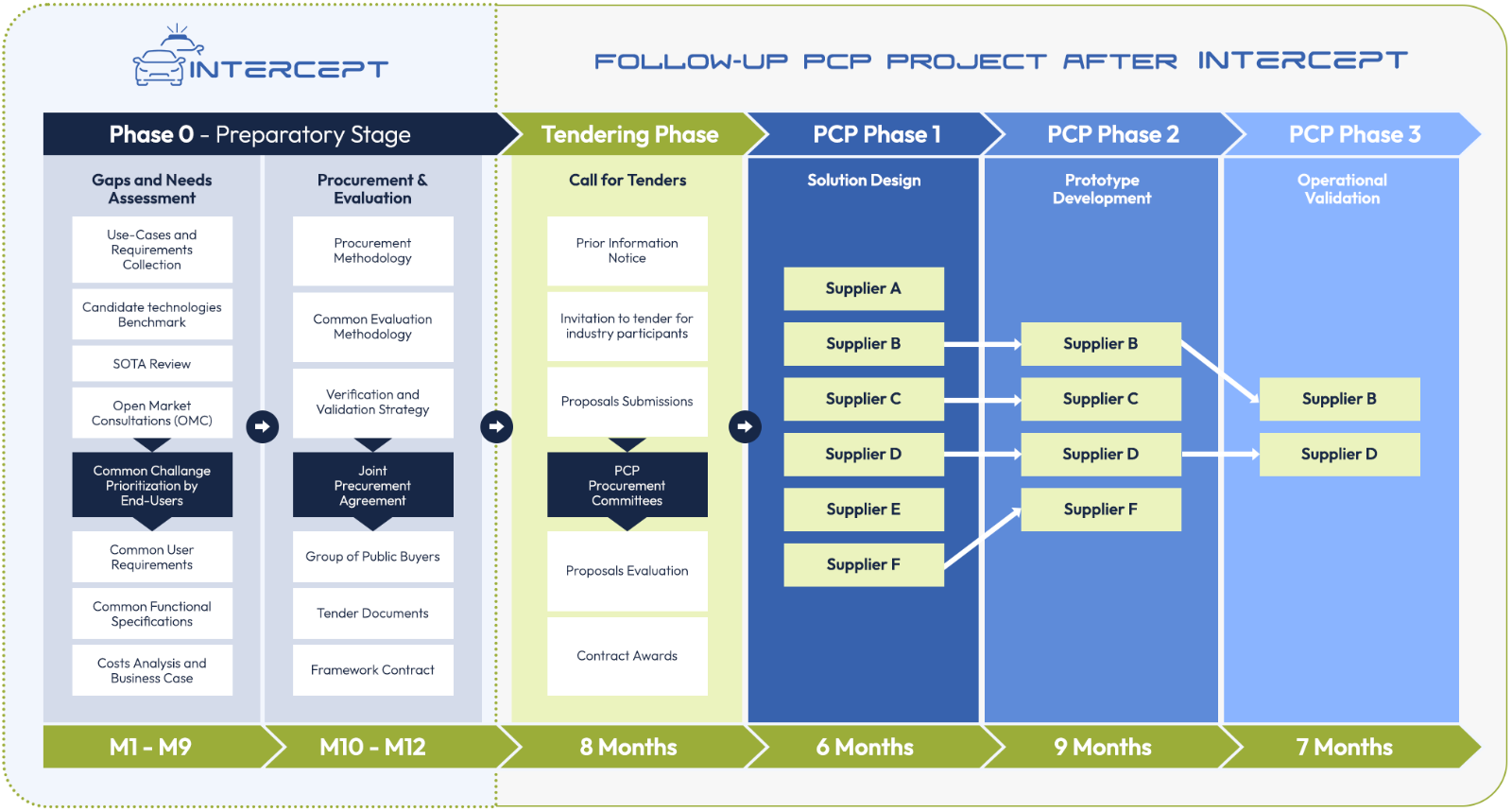

The Pre-Commercial Procurement (PCP) is an approach that allows public procurers to buy research and development services from several competing technology providers in parallel, to compare alternative solution approaches, and to identify solutions that offer the best value-for-money and address their specific needs. The solutions are expected to achieve at Technology Readiness Level 7-8 (TRL 7-8).
PCP challenges innovative players on the market, via an open, transparent and competitive process, to develop new solutions for a technologically that meets demands within the public interest covering mid to long-term challenges. In PCP, there is a risk-benefit between the public procurers and the technology providers, and a clear separation between PCP and the deployment of commercial end-products at volume.


PCP is designed to facilitate the procurement of research and development services where the output provides broad benefits to multiple end-users. Therefore, it is exempt from the provisions of the European Directives on public procurement, which typically relate to applications where the contracting authority would benefit exclusively.
The PCP approach can support public buyers and industry players, while also benefiting society. This method saves taxpayers’ money invested in innovative products, helps to address environmental and social challenges, creates high-value-added jobs in Europe, and contributes to sustainable economic growth.